CHAPTER THIRTY-TWO
A Beer, a Brat, and Cancer
Read this chapter aloud
Uses your device’s built-in voice.
I know where the second-guessing comes from. Or at least, my therapist does.
She says it’s about early inconsistency. How I never quite knew which version of someone I’d get. How I learned to anticipate danger by obsessively scanning for micro-reactions.
Sounds clinical when she says it.
I just call it Tuesday.
My dad died when I was young.
But honestly, he wasn’t exactly winning Father of the Year before that.
Not that I blame him. I mean, I was me.
I was dramatic. Sensitive. Oversharing. Overtalking. Probably overwearing some kind of vest.
But also, sometimes, a total recluse. Moody. A little asshole. Confused about how to be. Didn’t want attention. Desperately needed it. Tried to act chill while secretly unraveling.
And somehow, I still managed to piss him off.
One time in high school he bought me a school jacket.
A letterman jacket. Big deal. Symbol of achievement. Tribal badge of high school honor.
I had just earned my basketball letter. One single glorious L. And I finally had something to sew onto it.
Some guys had ten. Some had fifty. I don’t even know how. Maybe they stole them. Maybe they forged them. Maybe they were just that good.
I was honestly considering buying used letters off other dudes just to fill it out like an army general who’d seen some things.
But I had my one. My big, proud, varsity L.
So naturally, I gave the jacket away.
Immediately. To a girl I liked.
Because that’s how you announced a relationship back then. Not with an Instagram post or matching bios. You gave someone your jacket.
And mine actually had a letter on it.
He lost it.
And it didn’t help that right before that, I had rigged the kitchen sink with a rubber band around the sprayer.
So when he turned on the faucet to yell at me mid-rant, he sprayed himself in the face.
Then stormed back to yell some more. And I, being who I am, decided the logical next move was to look him dead in the eye and say:
“Well, at least I don’t have a piece of bologna on my head.”
He had a bald spot. Not a big one. But noticeable.
Apparently not something he was feeling whimsical about.
So naturally, he turned around, went back to the kitchen to get a drink, and promptly sprayed himself again.
He came back and smacked me in the ear.
Not great. Not my favorite memory.
But also, what a sequence. You cannot write that.
He put up with a lot. I once drove our station wagon straight into the garage at age thirteen while practicing reverse. Unauthorized.
Another time he accidentally crushed my fingers in the window on a family trip, back when electric windows were brand new, and when I screamed “YOU MOTHERF***ER” in the car, he pulled over on I-75, got out, stood in front of the vehicle in the breakdown lane, and said:
“All right, bud. You want to go? Let’s rumble.”
And my mom, from the passenger seat, deadpan:
“Rick. What do you think this is? West Side Story?”
Here’s the thing my therapist asked me that I did not have an answer for.
She asked who I had looked up to instead.
And I gave her the honest list.
David Hasselhoff. Mister Rogers. Jim Henson. And Riki Rachtman from Headbangers Ball.
She wrote all four down. Slowly.
David Hasselhoff.
Mr. Rogers.
Jim Henson.
Riki Rachtman.
Not Rikki Rockett. Different Riki. This family had already done enough with poison. And turpentine.
One taught me confidence. One taught me kindness. One gave me puppets. One hosted Headbangers Ball and scared my mother.
Assemble that lineup and squint, and a father emerges. Half earnest, half leather, unashamed of his own theme music.
I’ve met worse men. I’ve been worse men.
It’s not the worst cocktail. It does explain why I keep over-apologizing while wearing fingerless gloves.
But I want to say the quiet thing about that list, because it took me until my forties to notice it.
Every single one of those men was on television.
Every one of them was a person performing warmth at a camera, into a room I was sitting in alone, who could not see me and would never ask me anything.
I did not build a father out of pieces.
I built one out of broadcasts.
And then I spent thirty years trying to become one.
For most of my life I had a theory about my dad and me, and my mother handed it to me in pieces over the years.
She was young when she had me. Too young, she says now. And for the first five years or so, I was hers. Her clay. Her project.
She kept my dad at arm’s length without quite meaning to, the way a kid does with a new toy she isn’t ready to share.
By the time my brother came along, my dad had apparently decided he was not going to be kept out of that one. Not again.
He started fresh with Rick.
And the story I built out of all that, the one I carried around for three decades, was that he’d looked at me, done some quiet math, and given up before I could throw a ball or ruin a jacket.
I used to push her on it. We’re only five years apart, Mom. Something could have shifted. He had time.
She never really had an answer. She’d just get quiet, which from my mother is its own kind of answer.
When I was a kid I used to tell her, flat out, that I didn’t think my dad liked me. That he was always with my brother, never me.
She’d go somewhere else when I said it, somewhere I couldn’t follow, and then come back with the same answer every time.
“He’s just jealous, honey. He can’t play a note. He’d never in a million years get up on that stage and do what you do.”
And I’d say, “Nobody’s forcing him to, Mom. You’re forcing me.”
She never had a comeback for that one. She’d just look at me.
Which, from a woman who has a comeback for everything, told me more than any comeback ever could.
I filed the whole thing under things mothers say to kids who ask why their dad won’t look at them.
Even when his cancer got bad, brain cancer bad, there were still moments of absurd brilliance.
One of the last nights I had with him, he could barely move. Couldn’t sit up. Couldn’t eat much.
But he told me, clear as day, that all he wanted was a good old-fashioned beer and a brat, and to listen to the Cincinnati Reds.
Actually, that’s the version I tell at parties.
What he actually said, deadpan, flat as Ohio, was that all he wanted was “a beer, a brat, and cancer.”
Because he already had the cancer, see.
Might as well complete the set.
The hospice nurse did not know what to do with that.
I did.
You laugh.
That was the entire instruction manual he left me, and I have been following it ever since.
So I did it right.
I grilled him a brat on the patio and threw a frosted mug in the freezer. Waited an hour. Got the beer cold enough to need its own passport.
I brought it all in, proud of the effort, like this was going to be a real moment.
I leaned in to help him up. Figured maybe this was the time he’d say something meaningful. Some father-son clarity to land the plane.
Instead, he squinted at me and said:
“You stink.”
That was it.
A full-body effort, from a dying man, to deliver an insult with surgical precision.
He couldn’t remember what day it was, but he made sure I knew I was musty.
That’s love, I think. In its weirdest form.
For years I filed all of this under anger. I did whole seasons of therapy on the anger.
Turns out the anger was just the coat rack.
What was hanging on it was simpler, and worse.
I just miss him.
Especially now. Especially with Leo.
He would have loved Leo.
Then last week I found a letter.
In a box, in my closet, while I was looking for something else entirely.
He wrote it near the end, when the tumor had him.
For years I’ve told people that my brother got three full pages of fatherly wisdom, framed now, up on a wall, in that handwriting of his that never stopped riding the lines even as everything else fell apart.
And that I got a few lines that barely filled half a page.
That was the story. The scrap. Proof of the arrangement.
It’s longer than I remembered.
It’s still not three pages.
Here it is, and I am not cleaning it up, because he didn’t.
Brandon, I just wanted to take the time to write you a note and tell you a few things of my mind (Which is very confused right) now. You probably think of me as a pain in the ass always bitching about something which is true, but I hope you know how much I love and enjoy you from the day you were born you are a special kid with lots of potential who needs to move now and do what God intended for you to do. Maybe what is happening will somehow be positive for you. You know the word I used potential, Brandon you have the ability to do anything you set your mind to do, but you need to start now! Take responsibility you can do it. Maybe I didn’t give you the proper direction growing up but I do love you very much and am very proud of you. I wish I had your intelligence, wit, humor.
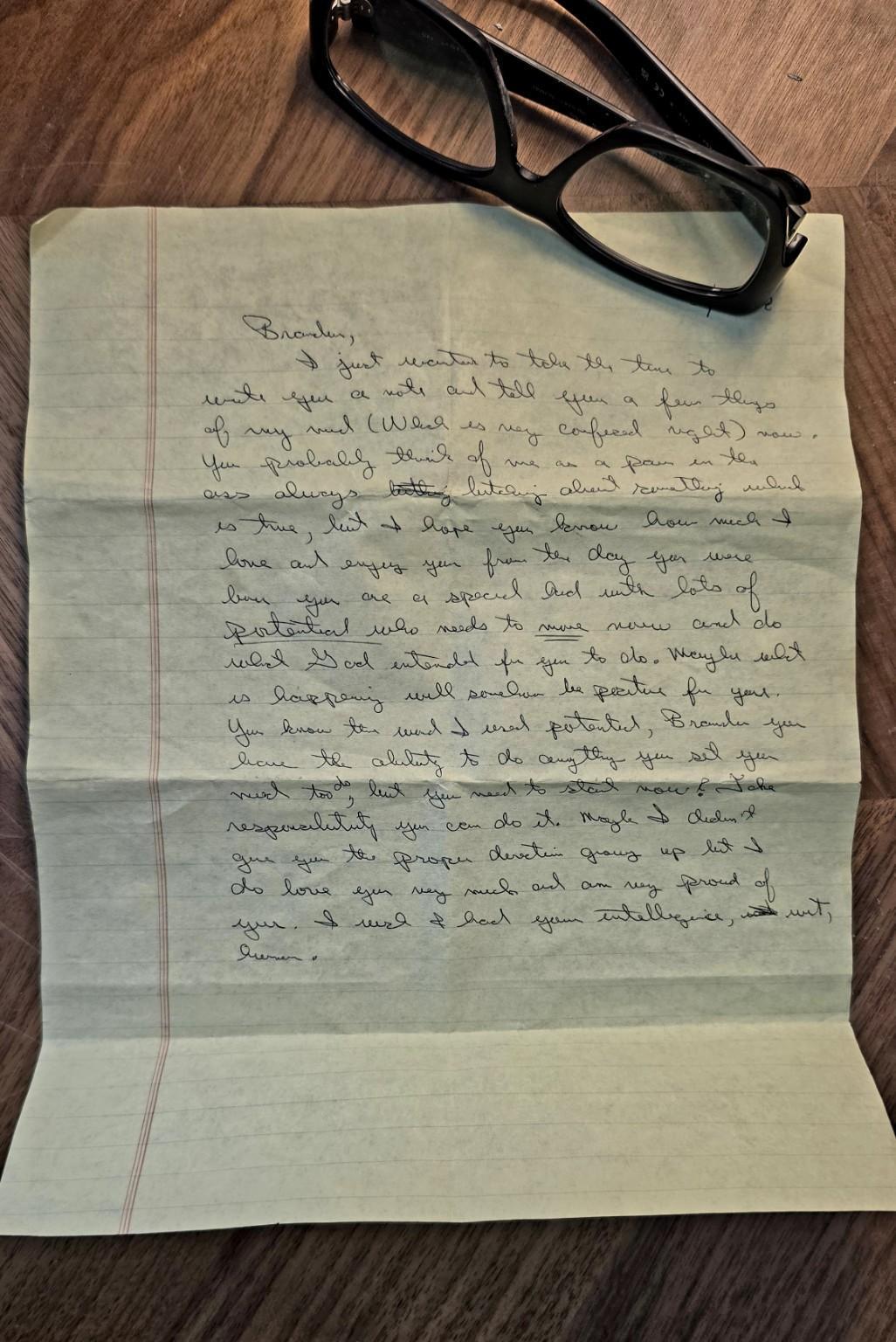
That is the last line.
It ends on the word humor, and then nothing. No signature that I ever found.
He listed the things he loved about me and stopped on that one.
He underlined one word twice.
Not “sorry.” Not “love,” though the love is all over the page.
Move.
A man who could barely hold the pen pressed down hard enough on that one to tear the paper a little.
He spent the letter apologizing for not giving me direction, and the only direction he underlined was the one I spent the next thirty years not taking.
And there it is, in his own hand.
I wish I had your intelligence, wit, humor.
For years my mother told me he was jealous of me, and for years I heard that as a thing mothers say.
It’s his handwriting. Not hers.
I don’t know what he meant by it, or how long he thought about it, or whether he’d have said it out loud in a room with the lights on.
I just know those are the words, and that he chose to end on them, and that a man does not spend one of his last coherent hours listing the things he wishes he had unless he has been keeping the list a while.
For thirty years I read that letter as proof he’d given up on me.
I’d like to think I had it backward.
I can’t ask him, so I don’t get to know for sure.
But a man who gave up doesn’t end his last note to you on the word humor, and I am choosing to keep it that way.
I only understand that now, which is the cruel part, because I only understand it from the other side of it.
My son is twelve.
He’s going quiet the way they do. Becoming a whole person in a room I keep getting locked out of. Answering in syllables. Closing a laptop when I come in, not because there’s anything on it, but because it’s his.
And some nights I catch myself standing near his door, not knocking, running the exact math I spent my entire life accusing my father of running.
He doesn’t want me in there. He’d rather it was somebody else. I’ve lost him and I don’t know at what point it happened.
That’s what I want to say to my father, and cannot, and so I’m saying it to you.
It isn’t giving up. It’s just how far away they drift while you’re still standing right there. Loving them completely. In the hallway. Not knowing which word to underline.